
Global / English
Design Technology for Fabric Softener Bases Adapted to Diverse Washing Conditions in ASEAN
Material Development
Fabric softeners adsorb onto fiber surfaces and form a smooth layer, known as a lubricating layer. This layer reduces friction between fibers and gives fabrics a soft feel. Fabric softeners also help reduce static electricity and improve the ease of handling laundry after washing, such as when drying and folding clothes.
These functions largely depend on the condition of the lubricating layer formed on the fiber surface. In general, fabric softener bases form bilayer structures in water and exist in a stabilized state as vesicles, which are capsule-like structures. These vesicles adsorb onto fiber surfaces and form a lubricating layer, thereby providing a softening effect.
In ASEAN, however, environmental conditions such as water quality, particularly the concentration of hardness components, temperature, and humidity vary widely by country. These conditions may affect vesicle stability, particle structure, and adsorption behavior on fiber surfaces, leading to variations in softening performance. In addition, requirements for sensory qualities such as fragrance longevity, milky appearance, and viscosity are diverse, making it a technical challenge to achieve both softening performance and these sensory qualities.
At Kao Industrial (Thailand) Co., Ltd (KIT), we address these challenges through molecular design and interfacial control. Specifically, we design vesicle structures by optimizing alkyl chain length distribution, ester composition, and additives, and control adsorption behavior on fiber surfaces. This enables stable formation of the lubricating layer even under different environmental conditions. We also consider interactions with fragrance and other ingredients to achieve a balance with sensory qualities such as milky appearance, viscosity characteristics, and fragrance retention.
In addition, we conduct performance evaluations under practical-use conditions, including comparative testing with DSDMAC, a representative conventional fabric softener base.
- Comparison of fabrics treated with water, DSDMAC, and TETRANYL
- Test conditions: immersed in a 0.1% surfactant solution for 5 minutes, then dried for 1.5 hours
- Evaluation method: a load was applied to folded fabric (1 kg for 1 minute), and wrinkle formation was compared
As a result, the TETRANYL-treated fabric showed a tendency to suppress wrinkle formation, suggesting that improved softness contributes to shape stability.
-
* This result was obtained under specific test conditions and does not represent all usage environments.
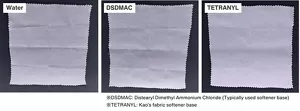
Wrinkle Reduction Effect of Fabric Softener Bases
In this way, the key feature of this technology is its ability to combine molecular-level design with control of interfacial behavior to achieve both stable softening performance and sensory qualities under washing conditions that differ by region. Through this material design technology, KIT will continue to develop fabric softener bases adapted to the diverse living environments of ASEAN.
- Home
- Innovation
- Research & Development
- Global Network
- Design Technology for Fabric Softener Bases Adapted to Diverse Washing Conditions in ASEAN
- Home
- Innovation
- Research & Development
- Global Network
- Design Technology for Fabric Softener Bases Adapted to Diverse Washing Conditions in ASEAN