
Global / English
Research on New Hygiene Technologies to Address Invisible Infection Risks
Microbial Control
In Taiwan, a hot and humid climate, together with a deeply rooted culture of eating out, means that infections caused by bacteria and viruses are reported every year. Secondary infections via infected individuals can also occur, making infection risks difficult for consumers to recognize and creating an ongoing need for hygiene measures.
Alongside its work on bacteria-related hygiene, Kao Asia Research Laboratories (Taiwan) has focused on human norovirus, which is less susceptible to common alcohol-based disinfectants and can cause infection even in very small amounts. Viruses are broadly classified by structural differences into enveloped viruses, which have a lipid membrane, and non-enveloped viruses, which do not. Human norovirus belongs to the latter group and is one of the viruses that can be difficult to inactivate. In collaboration with external research institutions and Kao’s research teams in Japan, a new method for evaluating human norovirus inactivation efficacy*1 has been utilized, and technology development has been pursued to combine inactivation efficacy against non-enveloped viruses with action against bacteria.
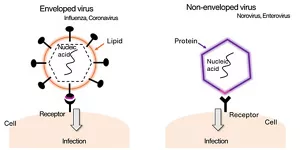
Enveloped and Non-enveloped Viruses
Viruses can be broadly classified into two types based on whether they have a lipid membrane (envelope). Human norovirus is classified as a non-enveloped virus, a type that is less susceptible to common alcohol-based disinfectants.
As the first application of this technology, it was applied to laundry detergents. A proprietary mildly acidic formulation was designed to deliver these functions under ordinary laundering conditions, enabling the proposal of new hygiene value that goes beyond cleaning clothes.
However, measures against contact infection via clothing alone are not sufficient. Human norovirus has multiple secondary transmission routes, including contact infection via hands and household surfaces, droplets generated during care or cleaning, and dust remaining in living spaces. Looking ahead, the application of this technology will be expanded with multiple infection routes in mind and comprehensive solutions will be proposed to help protect consumers more safely and reliably from invisible infection risks. Through these efforts, we will continue to contribute to healthier and more secure everyday lives.
- Home
- Innovation
- Research & Development
- Global Network
- Research on New Hygiene Technologies to Address Invisible Infection Risks
- Home
- Innovation
- Research & Development
- Global Network
- Research on New Hygiene Technologies to Address Invisible Infection Risks