
Global / English
Compensation System for Directors, Audit & Supervisory Board Members, and Executive Officers
As of March 26, 2026
Purpose of Executive Compensation
Executive compensation levels and structures are determined in line with the following objectives.
- Secure and retain diverse and excellent talent to establish and improve competitive advantages.
- Promote prioritized measures for continuous increases in corporate value.
- Share interests in common with shareholders and other stakeholders.
Composition of Executive Compensation and Composition Ratio
Compensation for Directors and Executive Officers, excluding Outside Directors, consists of base compensation, short-term incentive compensation, and long-term incentive compensation. Outside Directors receive base compensation and non-performance-linked stock compensation. Audit & Supervisory Board Members receive base compensation only.
Non-performance-linked stock compensation for Outside Directors was introduced in April 2026. In addition to strengthening oversight and advice from an independent standpoint, this program promotes share ownership and supports initiatives that enhance corporate value while aligning interests with stakeholders.
Compensation Structure

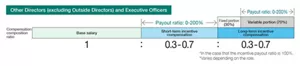
The levels of compensation for Directors, Executive Officers, and Audit & Supervisory Board Members are determined each year after ascertaining the levels of other major manufacturers of a similar size, industry category, and business type to Kao and other companies that are comparable to Kao in terms of the direction of management strategies and business form, using officer compensation survey data from an external survey organization.
Overview of the Incentive Compensation System
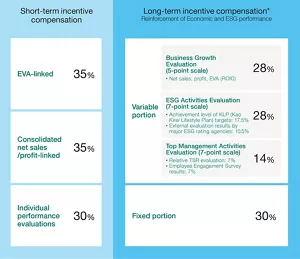
The Board of Directors determines the incentive compensation system and performance evaluation framework following deliberation by the Compensation Advisory Committee, whose majority members are Outside Directors. For individual performance evaluations of Directors, Outside Directors evaluate the President & CEO. The Compensation Advisory Committee evaluates other Directors through deliberation among its members.
Composition of Incentives
In the case of President and Chief Executive Officer, Representative Director
-
* Directors and Executive Officers, excluding Outside Directors, receive fixed and variable compensation. Outside Directors receive fixed (non-performance linked)compensation only.
Compensation Paid to Directors in FY2025
(million yen)
| Category | Number of members | Aggregate amount of remuneration, etc. |
Components of remuneration | |||
|---|---|---|---|---|---|---|
| Base salary | Short-term incentive compensation (performance- based bonus) |
Long-term incentive compensation (performance-based stock compensation) |
||||
| Variable portion | Fixed portion | |||||
| Directors (including, in parentheses, Outside Directors) |
10 (5) | 767 (92) | 414 (92) | 167 (-) | 133 (-) | 53 (-) |
| Audit & Supervisory Board Members (including, in parentheses, Outside Audit & Supervisory Board Members) |
7 (4) | 138 (53) | 138 (53) | - (-) | - (-) | - (-) |
| Total (including, in parentheses, Outside Directors and Outside Audit & Supervisory Board Members) |
17 (9) | 905 (145) | 552 (145) | 167 (-) | 133 (-) | 53 (-) |
-
* 1 The above numbers of Directors/Audit & Supervisory Board Members include one Inside Director, one Inside Audit & Supervisory Board Member, and one Outside Audit & Supervisory Board Member who resigned at the conclusion of this 119th Annual General Meeting of Shareholders held on March 21, 2025.
-
* 2 Of the long-term incentive compensation (performance-based stock compensation), for foreign directors for whom it is not appropriate to grant shares due to the laws and regulations of their country of residence, an amount equivalent to long-term incentive compensation (performance-based stock compensation) is scheduled to be paid in cash. The variable portion of the long-term incentive compensation (performance-based stock compensation) will be finalized on the final year of the applicable period of four fiscal years from 2024 to 2027 of the Mid-term Plan “K27.” As such, the variable portion equals the amount of provision for long-term incentive compensation recognized in the current fiscal year. For the variable portion paid to directors who retired during the fiscal year, the difference between the reversal of provisions from prior fiscal years based on the level of achievement in the annual review and the provision amount recorded for the current fiscal year is presented.
-
* 3 The maximum amounts of remuneration, etc. are as follows:
(1) Maximum aggregate amount of monetary remuneration, etc., to be paid to Directors:
An annual amount of 630 million yen (as resolved at the 101st Annual General Meeting of Shareholders held on June 28, 2007). The Company had 15 Directors (including two Outside Directors) at the conclusion of this Annual General Meeting of Shareholders. Such maximum aggregate amount includes the maximum annual amount of 100 million yen to be paid to Outside Directors (as resolved at the 110th Annual General Meeting of Shareholders held on March 25, 2016) but does not include the salary amounts, etc. to be paid to Directors who also serve as employees of the Company, for their service as employees. The Company had seven Directors (including three Outside Directors) at the conclusion of this Annual General Meeting of Shareholders.
Based on a resolution adopted at the 118th Annual General Meeting of Shareholders held on March 22, 2024, the Company has introduced a performance-based share incentive plan for its Directors (excluding Outside Directors) and its Executive Officers, which shall be applicable separately from the maximum aggregate amount of monetary remuneration, etc., for Directors. Under this share incentive plan, trust money of up to 4.64 billion yen is contributed during the fiscal years subject to the Company’s mid-term plan (the initial period to be covered being the period of four fiscal years from the fiscal year ended December 31, 2024 to the fiscal year ending December 31, 2027), and the Company’s shares are acquired through a trust and are then vested, etc., through the trust, based on the evaluation indicators consisting of Business Growth Evaluation indicators (such as the degree of growth in overall business sales, profit, and EVA), ESG Activities Evaluation indicators (status of realization of internal indicators and evaluation by external indicators), and Top Management Activities Evaluation indicators (TSR (Total Shareholder Return) and evaluation of management activities by the Company’s employees etc.). The Company had four Directors (excluding Outside Directors) at the conclusion of this Annual General Meeting of Shareholders.
(2) Maximum aggregate amount of remuneration, etc., to be paid to Audit & Supervisory Board Members:
An annual amount of 180 million yen (as resolved at the 118th Annual General Meeting of Shareholders held on March 22, 2024). The Company had five Audit & Supervisory Board Members (including three Outside Audit & Supervisory Board Members) at the conclusion of this Annual General Meeting of Shareholders. -
* 4 Aggregate amount of remuneration, etc. paid to Outside Directors and Outside Audit & Supervisory Board Members by the Company’s subsidiaries, etc., other than the aggregate amount of remuneration, etc. paid to Outside Directors and Outside Audit & Supervisory Board Members:
Remuneration paid to one Outside Audit & Supervisory Board Member for his service as an Audit & Supervisory Board Member of Kao Group Customer Marketing Co., Ltd. was 4 million yen.
Compensation Paid for Individual Directors in FY2025
| Name (title) |
Aggregate amount of remuneration, etc. (millions of yen) |
Company category |
Components of remuneration (millions of yen) | |||
|---|---|---|---|---|---|---|
| Base salary | Short-term incentive compensation (performance-based bonus) |
Long-term incentive compensation (performance-based stock compensation) |
||||
| Variable portion | Fixed portion | |||||
| Yoshihiro Hasebe (Director) |
281 | Reporting company |
87 | 97 | 69 | 29 |
| Masakazu Negoro (Director) |
119 | Reporting company |
49 | 35 | 25 | 10 |
| Toru Nishiguchi (Director) |
119 | Reporting company |
49 | 35 | 25 | 10 |
| David J. Muenz (Director) |
130 | Reporting company |
122 | - | 8 | - |
-
* 1 The variable portion of the long-term incentive compensation (performance-based stock compensation) will be determined at the end of the final fiscal year of the four fiscal years from 2024 to 2027, which are subject to our mid-term management plan “K27.” Therefore, the variable portion will be recorded as an accrued amount for the current fiscal year. For the variable portion attributable to a director who retired during the fiscal year (Mr. David J. Muenz), the company present the difference between the amount of the prior-year provision accrued or reversed based on the achievement level confirmed in the annual review and the amount accrued and recognized for the current fiscal year.
-
* 2 The table above includes information only on those whose aggregate remuneration, etc. exceeds 100 million yen.
- Home
- About Kao
- Our Core of Management
- Corporate Governance
- Compensation System for Directors, Audit & Supervisory Board Members and Executive Officers
- Home
- About Kao
- Our Core of Management
- Corporate Governance
- Compensation System for Directors, Audit & Supervisory Board Members and Executive Officers