
Global / English
Research on Microbial Risk Mapping to Visualize “Invisible Hygiene Risks” in Living Environments in China
Home Hygiene
Since the spread of COVID-19, consumers have become increasingly aware of invisible microorganisms that exist in their living environments. At the same time, because microorganisms cannot be seen with the naked eye, it is not easy for consumers to accurately understand where hygiene risks may exist in their homes.
To contribute to creating more hygienic and reassuring living environments for consumers in China, Kao China Research & Development Center (KCRC) conducted a study on microorganisms and mite allergens in household environments in Shanghai. KCRC visited 100 households with preschool children across six administrative districts, including both urban and suburban areas, and collected samples from frequently touched areas in daily life, such as kitchens, bathrooms, toilets, bedrooms, and living rooms.
In the study, KCRC measured the total number of bacteria and fungi on surfaces at 36 locations in each household, while also examining specific microorganisms such as coliform bacteria and Staphylococcus aureus. In addition, house dust samples were collected from seven locations in bedrooms and living rooms to measure mite allergens. Based on the collected data, KCRC evaluated the hygiene conditions of each location relatively by referring to hygiene-related standards and differences in distribution among households and organized the results as priorities for hygiene management.
The results showed that the distribution of microorganisms differed depending on the area of the home. Moderate levels of risk were observed in areas that come into contact with food, such as knife handles, cutting boards, kitchen sponges, and vegetable and fruit storage areas in refrigerators. Higher levels of risk were also found around areas where moisture tends to remain, such as kitchen sinks, silicone seals, and drains in bathrooms and toilets. The study also indicated that attention should be paid to places that consumers touch in daily life, such as living room floors and carpets.
Based on these findings, KCRC developed a “Microbial Risk Map for Living Environments,” which organizes microbial risks by location within the home. By visualizing invisible hygiene issues in an easy-to-understand way, the map is designed to help consumers understand which areas of the home require attention and to support everyday hygiene practices.
Going forward, Kao will continue to deepen its understanding of microorganisms in living environments and advance research that helps consumers correctly understand familiar hygiene issues and take appropriate action. Through scientific knowledge of living environments, Kao will contribute to realizing more hygienic, reassuring, and comfortable everyday lives.
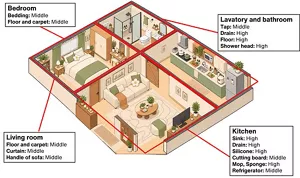
Microbial Risk Map for Living Environments
- Home
- Innovation
- Research & Development
- Global Network
- Research on Microbial Risk Mapping to Visualize “Invisible Hygiene Risks” in Living Environments in China
- Home
- Innovation
- Research & Development
- Global Network
- Research on Microbial Risk Mapping to Visualize “Invisible Hygiene Risks” in Living Environments in China