
Global / English
Waste PET Boosts Asphalt Pavement Durability
Developing a new asphalt modifier that improves durability while helping reduce lifecycle impacts
Asphalt is widely used for roads and parking lots, yet rutting and other damage can build up over time under heavy loads and ageing—durability remains a persistent challenge.
Kao’s Chemical Business has developed an asphalt modifier made from hard-to-recycle waste PET* , including used PET bottles. By adding just 1% of this waste-PET-derived modifier to asphalt, pavement durability can be increased by up to five times—helping reduce repair frequency and the associated burdens of road maintenance.
-
* Polyethylene terephthalate
Aiming to combine high durability with lower environmental impact
The project began with a customer request to improve asphalt performance—especially pavement durability. We set out to develop an asphalt modifier to address this need. At the same time, we worked to reduce the environmental impacts associated with road repairs and the production of paving materials. That work led us to the use of hard-to-recycle waste PET.
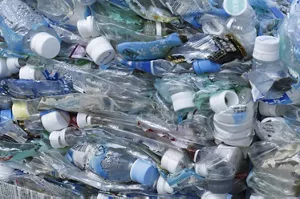
Hard-to-recycle waste PET
Upcycling waste PET dramatically improves durability
Most PET used to make PET bottles is recycled, but not all of it. Some PET cannot be mechanically recycled due to contamination, inconsistent quality, and other factors. Kao uses chemical recycling to repurpose this otherwise hard-to-recycle waste PET.
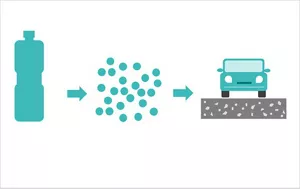
We crush and chemically process waste PET to produce an asphalt modifier, drawing on our expertise in interfacial science.
Because of PET’s surface properties (including its hydrophilicity), it can help strengthen adhesion between asphalt and aggregate. With just 1% added to conventional asphalt, pavement durability can improve by up to five times. This can reduce repair frequency and material use—helping lower the overall environmental footprint.
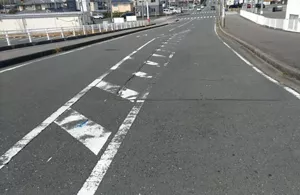
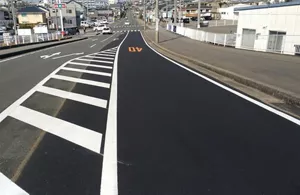
Conventional asphalt pavement (left) and high‑durability asphalt pavement (right)
Looking toward global deployment and contributing to an autonomous-driving society
This waste-PET-derived asphalt modifier—which combines high durability with lower environmental impact—is expected to be used not only in Japan but also in other markets worldwide.
In many regions, heavier traffic volumes and harsher vehicle operating conditions place greater stress on pavement, and the need to extend road life continues to grow. This has led to growing interest in asphalt modifiers that improve durability worldwide.
At the same time, as autonomous driving technologies advance rapidly, roads are expected to meet even higher standards of durability than ever before. This waste-PET-derived modifier is also gaining attention as a material that can support the transition to autonomous mobility.
Kao will continue to explore the potential of this technology and help create pavement that is friendly to both people and the environment—supporting a more sustainable world from the ground up.
Related Information
- Home
- Newsroom
- Kao Stories — Our Journey Toward a More Sustainable Future
- Waste PET Boosts Asphalt Pavement Durability: Developing a new asphalt modifier that improves durability while helping reduce lifecycle impacts
- Home
- Newsroom
- Kao Stories — Our Journey Toward a More Sustainable Future
- Waste PET Boosts Asphalt Pavement Durability: Developing a new asphalt modifier that improves durability while helping reduce lifecycle impacts