
Global / English
World-first*1 Verification of the Mechanism Underlying Perceptible Damage in Post-colored Hair and the Structural Changes That Occur Within Hair over 7 Days After Coloring
New Technology Suppresses Damage Progression, and Helps Keep Hair Color Beautiful
For the first time,*1 Kao Corporation’s Hair Beauty Research has discovered the connection between the structural change in proteins, which occurs within the hair, and the mechanism by which hair suffers dryness, frizziness and other damage that becomes perceptible around seven days after coloring. Further, because such a phenomenon is especially noticeable in black hair, Kao discovered the possibility that the mechanism may involve melanin, and has developed a new technology that reduces hair damage post-coloring and helps maintain luminous, full-bodied color.
Video: New Technology That Reduces Damage Within Post-colored Hair and Helps Keep Hair Beautiful
This research was presented at the 14th World Congress for Hair Research (May 28–31, 2026, Seoul, Korea).
-
* 1 First with respect to the phenomenon, in black hair, where generation of SH groups, accompanying disulfide (SS) bond cleavage within the hair, progresses for seven days after hair coloring. Kao searched academic papers on PubMed, the world’s leading scientific literature database for life sciences and biomedicine field, and Scopus, one of the world’s largest scientific abstract and citation databases. No publications describing “Generation of SH groups for seven days after hair coloring” were found as of May 29, 2026.
Background
Hair coloring is a familiar practice for fashion and self-expression. However, more than a few consumers must deal with hair damage, such as dryness and frizziness, caused by the coloring process. Since such damage has been believed to occur primarily during colorant application, research to date has focused principally on effects occurring during such application, while progressive changes in hair condition post-coloring have not been sufficiently studied. However, many consumers do report noticing a greater degree of damage approximately one week after coloring, compared to immediately post-coloring.
Consequently, Kao considered the possibility that damage progresses within the hair after coloring, and examined changes within the hair over the seven days post-coloring.
SS Bond Cleavage Progresses in Melanin-rich Black Hair During 7 Days After Hair Coloring
Hair is composed mainly of a protein called keratin, with SS bonds within the keratin functioning to maintain hair strength and shape. It is known that when SS bonds cleave and recombine irregularly, damage to the hair results, including dryness and frizziness. Kao hypothesized that damage noticed several days after coloring might be due in part to ongoing SS bond cleavage within the hair. Using SH groups generated by SS bond cleavage as a metric, Kao studied the internal condition of hair post-coloring.
Black hair tresses 15 to 20 cm long (“model tresses”) were dyed with a common oxidative hair colorant. The hair was observed immediately after coloring and again after seven days, using fluorescent microscopy*2 and a reagent that reacts with SH groups to emit light. Strong fluorescence was observed within the hair on Day 7 after coloring, confirming for the first time that SS bond cleavage was ongoing (Figure 1).
At the same time, in model tresses composed of white hair only, no bond cleavage was observed on Day 7 post-coloring, suggesting that melanin is involved in the post-coloring bond cleavage that is observed in black hair.
-
* 2 To visualize SH groups using fluorescence, Kao applied ABDF reagent to hair and developed a proprietary method to evaluate its internal condition. Results were stated as three-hair average values.
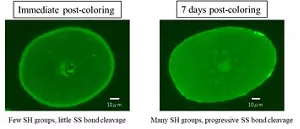
Figure 1. Comparison of SS bond states in black hair immediately and seven days post-coloring
Developing Technology to Help Prevent SS Bond Cleavage Post-coloring
Radicals*3 are known generally to be involved in SS bond cleavage. It has also been reported that levels of melanin radicals increase during the coloring process. Kao set out to investigate whether or not radicals are involved in SS bond cleavage post-coloring.
Black hair model tresses were dyed with a common hair colorant, followed immediately by one-hour immersion in aqueous solutions containing different components, before being rinsed. The tresses were then held under conditions*4 allowing the equivalent of three days of reaction to proceed, followed by examination using fluorescent microscopy. Tresses immersed in sorbitol or tocopherol solutions (both known to suppress radical generation) displayed the weaker fluorescence compared to tresses immersed in other solutions. Based on these findings, Kao developed Hair Link Protection Technology, which helps prevent SS bond cleavage associated with hair coloring, suppresses post-coloring damage and helps maintain luminous, full-bodied color.
Kao followed with a study involving three women who had black hair. After a standard hair color treatment, hair products with and without sorbitol and tocopherol were applied equally to hair on the left and right sides of the head, with results evaluated after seven days.*5 Where the product containing sorbitol and tocopherol was used, progression of dryness and frizziness over time was reduced, and hair was found to be easier to manage. In addition, undesirable yellow tones were less evident.
-
* 3 A highly reactive chemical substance that easily initiates changes in surrounding materials
-
* 4 Heating the hair and evaluating it under conditions that accelerate SS bond cleavage post-coloring
-
* 5 Immediately after hair coloring, a stylist applied the products, while on the following day (or the day after), participants applied it themselves. Results were evaluated using expert panel assessment by hairstylists and researchers as well as subjective evaluation by participants.
Summary
For the first time, Kao has demonstrated that SS bond cleavage, in proteins such as keratin and other associated proteins that make up the hair, progresses during the seven days following coloring, causing dryness, frizziness and color changes. Based on this discovery, Kao developed Hair Link Protection Technology.
This achievement is the product of more than 100 years of continuing hair care research by Kao, including accumulated analysis on internal hair structure and hair damage. Going forward, Kao will continue to develop technologies that anticipate and address the post-coloring changes that occur internally in hair before they can cause damage. By doing so, Kao will enable people to maintain beautiful hair while enjoying a more comfortable hair coloring experience.
About Kao
Kao, a Japan-based manufacturer of cosmetics, personal care and household products, as well as specialty chemicals, creates high-value-added products and services that provide care and enrichment for the life of all people and the planet. Through its brands such as Curél, SENSAI, and MOLTON BROWN cosmetics, Bioré and Jergens skin care products, Oribe hair care products, Attack laundry detergent, and Laurier sanitary products, Kao is part of the everyday lives of people across Asia, the Americas, Europe, the Middle East, and Africa. Combined with its chemical business, which contributes to a wide range of industries, Kao generates about 1,690 billion yen in annual sales. Kao employs about 31,500 people worldwide and has more than 130 years of history in innovation.
Please visit the Kao Group website for additional information.
Media inquiries should be directed to:
Public Relations
Kao Corporation