
Global / English
Development of Water Capturing Skin Technology
Corneocytes Spontaneously Draw in Surrounding Water, Increasing Their Water Content
Kao Corporation’s Skin Beauty 1 Products Research has developed Water Capturing Skin technology, which draws in surrounding water and increases stratum corneum moisture content. Kao further confirmed that this technology results in an increase in corneocyte moisture content over time using a microscopic ATR-IR method*1 , developed in-house.
This technology is expected to enable the development of skincare formulations that provide long-lasting moisturization through an approach distinct from conventional moisturizing methods that replenish and retain moisture.
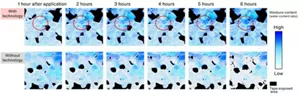
Corneocytes drawing in surrounding water and moisture content increasing over time with the new technology
-
* 1 After applying a formulation to the forearm, the stratum corneum is collected by tape stripping, and the signal intensity ratio of OH groups from water and polyols relative to protein (water content ratio) is visualized.
Background
Dryness is one of the most common skin concerns worldwide, and many technologies have been developed around moisturization as one of the most fundamental functions of skincare. However, moisture is easily lost over time, and many consumers still feel that skin does not remain hydrated after applying lotion.
Kao has deepened its research with a focus on the stratum corneum, the outermost layer of the skin, which is responsible for hydration and barrier function. In this study, Kao focused on the role of natural moisturizing factors (NMF) in maintaining moisture in corneocytes. Kao therefore set out to maximize the moisture-retaining function of NMF.
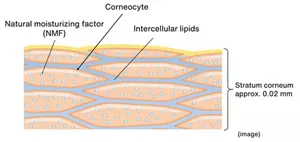
Stratum corneum structure
A specific combination of materials spontaneously draws in water from the surrounding environment
Various studies have been conducted on NMF to date. In the present work, Kao focused on the fact that NMF functions through a combination of multiple materials. Based on molecular structure and physical properties, Kao investigated combinations that would maximize water retention. Multiple NMF-derived substances were mixed at various ratios and left under ambient conditions for three days. It was found that mixing certain substances in specific ratios causes them to draw in water so strongly that the powder turned into a liquid (Figure 1).
Kao therefore began research to apply this strong water-absorption phenomenon to a new moisturizing approach.
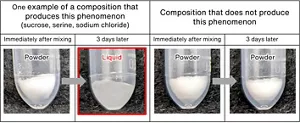
Figure 1. Moisture-absorption phenomenon caused by a specific material composition
Moisture content of the stratum corneum increases over time
Kao further explored combinations of substances that attract moisture and confirmed whether this phenomenon also occurs in the human stratum corneum. The inner forearms of three Japanese men and women aged in their 20s to 40s were treated with an aqueous solution containing the moisture-attracting composition and two aqueous solutions containing common moisturizing ingredients (comparative formulations A and B). Stratum corneum were collected by specialized tape immediately after application and at 3 hours and 8 hours after application, and moisture content (the signal intensity ratio of OH groups from water and polyols relative to protein, i.e., water content ratio) was measured using ATR-IR spectroscopy. While the moisture content of the stratum corneum decreased after application of the comparative formulations, it increased over time after application of the aqueous solution containing the moisture-attracting composition (Figure 2). These results suggested that the stratum corneum draws in surrounding moisture and retains it.
Based on these results, Kao developed the Water Capturing Skin technology, which promotes spontaneous capture of surrounding water through a specific combination of NMF-derived substances.
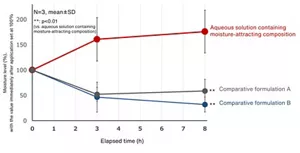
Figure 2. Increase in stratum corneum moisture content due to moisture-attracting composition
Moisture is drawn into the stratum corneum and retained
Transepidermal water loss (TEWL) was compared between an aqueous solution containing the Water Capturing Skin technology and a comparative formulation containing ingredients that enhance the barrier function of the stratum corneum in three Japanese men and women in their 20s to 40s. TEWL was measured before application and 8 hours after application and the change in TEWL was compared between two samples. The results showed that the aqueous solution with this technology suppressed water evaporation despite not containing conventional barrier-function-enhancing ingredients (Figure 3).
Kao considers that Water Capturing Skin technology may function both to draw moisture from the air into the stratum corneum and to retain within the stratum corneum water that would otherwise evaporate through the skin from within the body.
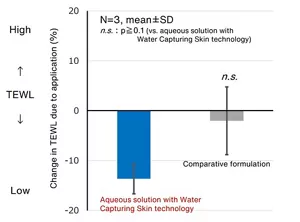
Figure 3. Comparison of transepidermal water loss (TEWL) before and 8 hours after application
Summary
Through the present work, Kao has developed Water Capturing Skin technology, which draws in surrounding moisture and increases stratum corneum moisture content using a specific combination of substances contained in NMF. Unlike the conventional moisturizing approach of replenishing and retaining moisture, this technology is a new moisturizing technology with the possibility of increasing moisture content over time. Kao will continue to work on the development of skincare technologies that deliver a greater sense of hydration.
-
* This news release is a translation of a Japanese‑language news release dated June 19, 2026.
About Kao
Kao, a Japan-based manufacturer of cosmetics, personal care and household products, as well as specialty chemicals, creates high-value-added products and services that provide care and enrichment for the life of all people and the planet. Through its brands such as Curél, SENSAI, and MOLTON BROWN cosmetics, Bioré and Jergens skin care products, Oribe hair care products, Attack laundry detergent, and Laurier sanitary products, Kao is part of the everyday lives of people across Asia, the Americas, Europe, the Middle East, and Africa. Combined with its chemical business, which contributes to a wide range of industries, Kao generates about 1,690 billion yen in annual sales. Kao employs about 31,500 people worldwide and has more than 130 years of history in innovation.
Please visit the Kao Group website for additional information.
Media inquiries should be directed to:
Public Relations
Kao Corporation