
Global / English
Quality Management System
Policies
Kao includes the concept of “Yoki-Monozukuri in plan & action” within the “Kao Way,” its corporate philosophy. This concept forms the foundation of our quality management activities. Based on the Kao Business Conduct Guidelines (BCG) and Kao Group Basic Quality Policy, we continually provide safe and high-quality products and services. In addition, we have established and maintain a quality management system and continually improve to further strengthen the trust that consumers and customers place in the quality, while contributing to the sustainable enhancement of corporate value.
Management structure
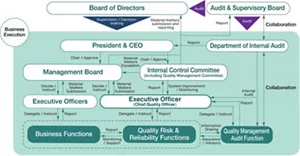
As Kao expands its businesses globally, we have built a management structure for quality management and are reinforcing governance with reference to the Three Lines Model that is widely used around the world. This enables us to reliably respond to increasingly diverse consumer and customer needs as well as changes in the business environment, while securing the safety, quality and reliability of our products.
- Business Functions: Serve on the front lines of business activities — such as Business, R&D, and SCM department— to ensure the quality of products and services through daily tasks.
- Quality Risk & Reliability Functions: Oversees and promotes quality management activities by building quality management systems and managing quality risks.
- Quality Management Audit Function: Evaluates governance related to quality management and the effectiveness of internal control processes, promotes improvements, and collaborates with Department of Internal Audit.
These organizations collaborate autonomously to build and improve the quality management structure. Kao’s Quality Management Committee, part of the Internal Control Committee, deliberates on and determines the company-wide basic policies and key measures pertaining to quality management, and ensures the effectiveness and reliability of company-wide quality management activities.
Document system
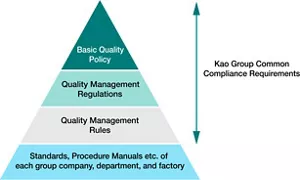
Kao has established a document system to promote globally consistent quality management activities. This system is structured with the Quality Policy at the highest level, supported by Quality Management Regulations that define company-wide requirements, and Quality Management Rules that set forth detailed operational requirements.
These documents define the basic philosophy and requirements for quality management to be upheld across the Kao Group.
Group companies, departments and factories have established guidelines and procedure manuals based on this document system, in line with the nature of their business and in compliance with laws and regulations in each country and region. By achieving a globally consistent quality management framework while also establishing operations that suit regional characteristics, we secure a level of quality that is trusted by consumers and customers worldwide while also making ongoing improvements.
Education
We hold ongoing education programs to support our quality management activities. These programs cover details on quality in light of the laws, regulations and culture of each country and region so that all employees can engage in their work with strong ethical standards. In addition to the introductory programs for new employees, we also provide annual education for personnel responsible for quality management, as well as managers and leaders in each department regarding relevant laws, regulations and internal standards, as well as education on quality management systems based on ISO 9001 and GMP in the form of on-demand and classroom-based training. Through these education programs, employees refine their capability to independently recognize challenges related to quality and drive improvements. As a result, they strive to maintain and enhance quality from the perspective of our consumers and customers.
Audit
To ensure the effectiveness of its quality management system and reduce quality risks, Kao positions audits as a key governance mechanism. The audits listed below are conducted to objectively confirm that quality management activities and quality risk management are functioning appropriately. Based on a risk-based approach that considers the likelihood and impact of quality risks, we determine the scope and timing of these audits and conduct them in a systematic and planned manner.
- Self-inspections and internal audits at Kao factories and other facilities
- External audits of raw material suppliers and outsourcing partners for manufacturing, conducted by SCM and Purchasing departments.
- Internal audits at the Business Functions (Business Departments, R&D and SCM), conducted by the Quality Risk & Reliability Functions.
- Internal audits at the Quality Risk & Reliability Functions, conducted by the Quality Management Audit Functions.
- Audits at Kao factories conducted by business partners.
Issues and risks identified through these audits are shared at Quality Management Meetings held to review the progress regarding key measures and issues related to quality. Participants deliberate on corrective and improvement actions to address these issues and risks, thereby helping to achieve ongoing improvements to quality management activities and the quality management system. The results of these audits and related improvement activities are also reported to and shared with the Quality Management Committee and are utilized to maintain and strengthen quality governance.
Related information
- Home
- Innovation
- Product Quality Management
- Kao Group Basic Quality Policy
- Quality Management System
- Home
- Innovation
- Product Quality Management
- Kao Group Basic Quality Policy
- Quality Management System